
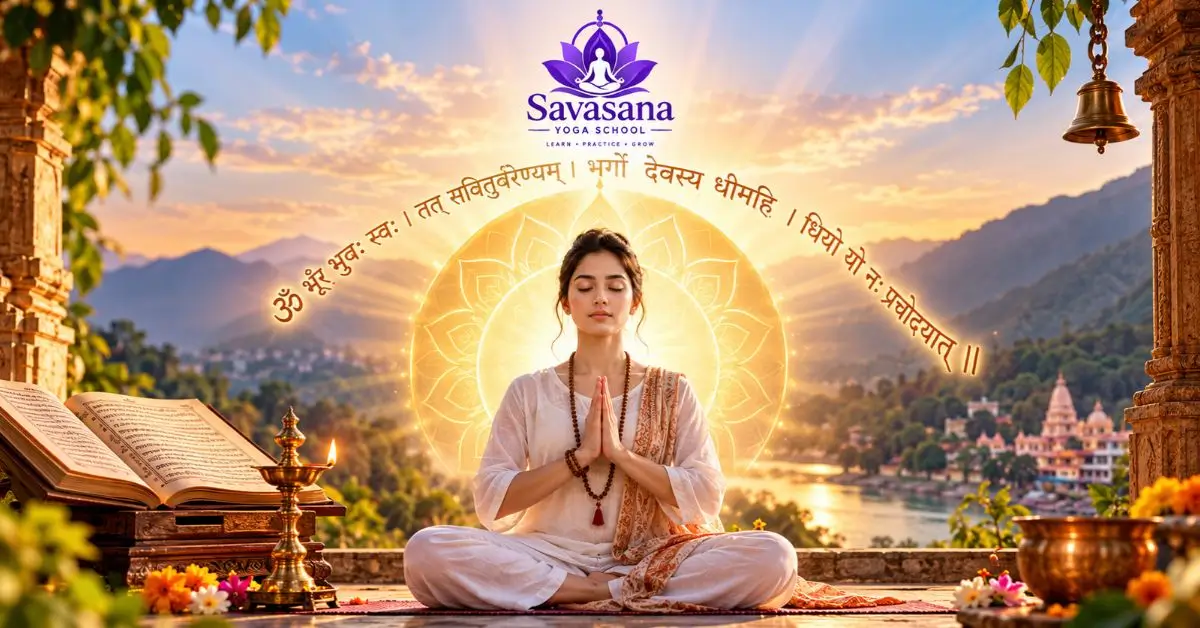
In this articleTable of Contents
The Gayatri Mantra is one of the well-known Vedic mantras in the Hindu tradition. It is often linked with light, deep thinking and wisdom. It is also considered a prayer for the brightening of the mind and the growth of understanding.
For many who practice it, the Gayatri Mantra is not a collection of Sanskrit words. When it is spoken or chanted, it helps create a peaceful atmosphere. This stillness allows for focus. The meaning behind the mantra guides the mind toward light and more profound awareness.
The mantra is found in Rigveda 3.62.10 and is traditionally attributed to the sage Vishvamitra. It is called the Gayatri Mantra because the verse is composed in the Gayatri meter, a Vedic poetic meter generally consisting of 24 syllables arranged in three groups of eight.
In everyday recitation, many people hear the mantra beginning with Om Bhur Bhuvah Svah. These three expressions are traditionally known as the mahavyahritis and are recited before the main Gayatri verse.
This guide explores the Gayatri Mantra meaning, its Sanskrit form, English interpretation, word-by-word explanation, traditional significance, and a simple way to approach chanting with awareness.
What is Gayatri Mantra?
The Gayatri Mantra is a Vedic Sanskrit verse dedicated to Savitr, a divine figure associated with the generative and illuminating power of the sun in the Vedic tradition.
The mantra appears as the tenth verse of the 62nd hymn in the third Mandala of the Rigveda: Rigveda 3.62.10. Sources discussing the mantra also identify it as the Savitr or Savitri mantra because of its association with Savitr.
The commonly recited form is
ॐ भूर्भुवः स्वः
तत्सवितुर्वरेण्यं
भर्गो देवस्य धीमहि
धियो यो नः प्रचोदयात्
Transliteration:
Om Bhur Bhuvah Svah
Tat Savitur Varenyam
Bhargo Devasya Dhimahi
Dhiyo Yo Nah Prachodayat
The first line is the traditional prefatory formula, while the core Vedic verse begins with Tat Savitur Varenyam.
Gayatri Mantra Meaning in English
A literal Sanskrit translation can vary depending on grammatical interpretation and the translator's approach. One established rendering of Rigveda 3.62.10 describes the verse as meditation upon the desirable or worshipful light of divine Savitr and a prayer that this divine power may inspire or enlighten understanding.
In accessible English, the idea can be expressed as “We meditate upon the radiant and worthy light of the divine Savitr; may that light inspire and guide our understanding.”
This wording is an interpretive translation rather than a claim that there is only one correct English rendering. The central idea is contemplation of divine light and a prayer for clearer understanding.
Om Bhur Bhuvah Svaha Meaning
People often search for Om Bhur Bhuvah Swaha meaning because these words are recited as part of the familiar expanded form of the mantra.
Om
Om is a sacred syllable widely used in Hindu, Buddhist, and yogic traditions. It is traditionally associated with the sacred sound of ultimate reality.
Bhur
Bhur is commonly associated with the earthly or physical realm.
Bhuvah
Bhuvah is traditionally associated with the intermediate or atmospheric realm and has also received broader philosophical interpretations.
Svah
Svah or Svaha in common modern transliteration is associated with the heavenly or celestial realm.
Together, Bhur, Bhuvah, and Svah are called the mahavyahritis, traditionally understood as sacred utterances that precede the Gayatri verse in certain recitation contexts.
It is useful to understand that these terms belong to traditional Vedic and Hindu cosmological interpretations rather than treating them as modern scientific descriptions of physical space.
Gayatri Mantra Definition
A simple Gayatri Mantra definition would be: A revered Vedic Sanskrit verse from Rigveda 3.62.10 that invokes the illuminating power of Savitr and expresses a prayer for the inspiration and guidance of the intellect.
The name “Gayatri” also refers to the poetic meter in which the verse is composed. The meter traditionally contains 24 syllables in three eight-syllable sections.
This distinction is important because “Gayatri” originally identifies a meter, while the specific verse known popularly as the Gayatri Mantra is the famous Savitr verse from the Rigveda.
Gayatri Mantra Meaning Word by Word
Understanding individual words can make the recitation more meaningful.

Tat
"Tat" means “that,” referring to something beyond ordinary limited description.
Savitur
Savitur refers to Savitr, the divine figure associated with the stimulating or life-giving power invoked in the verse.
Varenyam
Varenyam carries the sense of something worthy of choosing, honoring, or revering.
Bhargo
Bhargo is associated with radiant brilliance or effulgence and is traditionally interpreted in connection with illuminating power.
Devasya
"Devasya" means “of the divine” or “of the deity.”
Dhimahi
Dhimahi means “we meditate upon” or “we contemplate.”
Dhiyo
Dhiyo refers to the intellect, understanding, or discerning faculty.
Yo
"Yo" means “who” or “which.”
Nah
"Nah" means “our” or “for us.”
Prachodayat
Prachodayat expresses a prayer that the divine may inspire, impel, or guide the intellect.
Taken together, the verse expresses contemplation of divine radiance and a request for that radiance to inspire human understanding. Classical translations vary slightly in wording while retaining this central idea.
The Origin and Vedic Background
The Gayatri Mantra comes from the Rigveda, one of the surviving collections of Vedic Sanskrit literature.
The Gayatri Mantra is found in Mandala 3 Sukta 62 and Mantra 10. The Vedic Heritage portal explains that the Rigveda is arranged into Mandalas, Suktas and individual mantras, giving the structure that lets us locate passages like 3.62.10.
The Gayatri Mantra is traditionally linked to the sage Vishvamitra and the deity Savitr. The Gayatri Mantra is one of the frequently discussed and recited verses in the Vedic tradition.
Over time, the Gayatri Mantra became deeply rooted in Hindu ritual practices. The Gayatri Mantra is now known beyond the places where it first emerged. I feel the Gayatri Mantra resonates deeply with my heart.
Traditional Significance of the Gayatri Mantra
Traditionally, the mantra is connected with illumination, contemplation, wisdom, and the refinement of understanding. Rather than asking for a material object, the central prayer is directed toward the intellect.
This makes the final portion especially significant:
“Dhiyo Yo Nah Prachodayat”
I feel that the emphasis is on the inspiration or guidance of the intellect. Dhiyo Yo Nah Prachodayat's traditional interpretation helps explain why the mantra is often associated with study, meditation, reflection and spiritual discipline.
Different Hindu traditions may explain the mantra through philosophical frameworks. I notice that some people understand Dhiyo Yo Nah Prachodayat symbolism through Savitr and solar radiance while others see Dhiyo Yo Nah Prachodayat broadly as a link, to divine consciousness and spiritual illumination.
Benefits Traditionally Associated With Chanting
Traditional yoga and spiritual practices often link repetition to concentration, contemplation, discipline and inner awareness.
From a scientific viewpoint, it is more accurate to describe the benefits of chanting as possible outcomes of meditative or repetitive actions, rather than claiming that the Gayatri Mantra alone can cure a specific illness.
Mindful repetition can offer a focus for the mind, helping people ease into meditation more naturally.
The overall experience may vary based on how the mantra is said, breathing patterns, how many times the intention is repeated, the intention behind it, cultural background and personal beliefs.
Any claims that chanting the mantra heals sickness removes toxins ensures wealth, or leads to supernatural results should be seen as matters of faith or tradition—not as proven medical facts.
Also Go Through:- 100 Hour Yoga Teacher Training in Rishikesh
How to Chant the Gayatri Mantra?
You do not have to begin with a ritual. Beginners can start the mantra in an environment with a comfortable posture and by repeating attentively.
Step 1: Locate a Quiet Place
Find a clean and quiet place where you would not be disturbed.
Step 2: Choose your posture
You can either sit cross-legged, or you can kneel or sit on a chair while maintaining the natural, straight position of your spine.
Step 3: Find your breathing
- Take a couple of breaths before beginning.
- Do not force the inhalation or exhalation.
Step 4: Recite Slowly
- Chant the mantra at a pace while paying close attention to pronunciation.
- Beginners may start aloud so that they can become familiar with the words.
Step 5: Focus on the Meaning
While mechanically repeating the sounds, remember the main theme: the contemplation of divine light and a prayer for illuminated understanding.
Step 6: Quiet Ending
- Sit quietly for a short while after repetitions and watch your breathing and state of mind.
- The purpose is not speed or a specific number of repetitions.
- Consistency and attention can add meaning to the process.
When is the Best Time to Chant?
Traditionally, the Gayatri Mantra could be linked with the hours designated for prayer each day, particularly during the periods of the three sandhyas.
However, modern practitioners may include mantra recitation in a morning meditation, yoga session, or personal spiritual routine.
The most suitable time is one in which you can practice attentively without unnecessary interruptions.
Gayatri Mantra and Meditation
Mantra and meditation can naturally complement one another. The repeated Sanskrit sound gives the mind a point of concentration, while the meaning gives the practice a contemplative direction.
Instead of trying to eliminate every thought, simply return your attention to the mantra whenever your mind wanders. The technique can make the practice more accessible for those who find silence during meditation difficult.
Who Can Practice the Gayatri Mantra?
People from various backgrounds practice the mantra in many contemporary settings. Historically, its ritual use is particularly tied to Hindu traditions and connected to specific Hindu traditions and initiation practices, while modern practice has become much more widespread.
Sources discussing its history note that later Hindu reform movements contributed to its broader adoption. Because traditions differ, anyone seeking guidance within a particular lineage should follow the teachings and pronunciation conventions of that tradition.
Common Mistakes While Chanting
Rushing the Words
Fast repetition can make pronunciation unclear and reduce attention to the meaning.
Focusing Only on Sound
Correct pronunciation is valuable, but understanding the intention of the mantra can deepen the practice.
Forcing the Breath
There is no need to use aggressive breath control while chanting.
Treating Tradition as Medical Science
Spiritual claims and clinical evidence are different categories. A mantra can be meaningful within a spiritual practice without being a substitute for medical care.
Becoming Too Concerned About Perfection
Beginners may need time to learn Sanskrit pronunciation. Improvement comes with practice.
Final Thoughts
I find the Gayatri Mantra to mean thinking of light. The Gayatri Mantra specifically asks that this light guide and inspire understanding.
The Rigveda 3.62.10 verse, which connects the Gayatri poetic meter to Savitr, serves as the origin of this mantra. The known version that starts with Om Bhur Bhuvah Svah includes the traditional mahavyahritis before the main part of the mantra.
For someone practicing today the Gayatri Mantra can be seen as a way to work with sound focus the mind, reflect, and connect with spiritual ideas. Knowing what the words mean can make repeating the mantra feel more meaningful.
At the time it’s important to respect the difference between traditional beliefs and what science has confirmed. This helps keep the practice real and balanced.
Don’t think of the Gayatri Mantra as a fix for all problems. Instead, see it as a practice that helps you slow down pay attention and think about the idea of light and wisdom.
Questions & Answers
Q. What is the Gayatri Mantra?
Q. What is the Gayatri Mantra meaning in English?
Q. What is the Om Bhur Bhuvah Svaha meaning?
Q. What is the Gayatri Mantra definition?
Q. Who wrote the Gayatri Mantra?
Q. What does Gayatri mean?
Q. Can beginners chant the Gayatri Mantra?
Q. How many times should I chant the Gayatri Mantra?
Q. What are the benefits of chanting the Gayatri Mantra?
Q. When should I chant the Gayatri Mantra?
Comments (0)
Share a respectful question or reflection. Every comment is reviewed before it appears.
Be the first to start a thoughtful conversation.