In this articleTable of Contents
After a long day on a hard chair, the first thing many of us do is twist. We turn the shoulders, crack the back and sigh. Yoga builds that instinct into a full practice, with poses that rotate the spine slowly while the breath leads the way.
It explains twist yoga in plain language. You will learn how the spine actually rotates, which poses suit beginners, who should avoid them and how to build a short routine. It is written for international students who practice or plan to study in Rishikesh, where a good teacher can correct what a book cannot.
What is Twist Yoga?
A twist is any pose that rotates the spine and torso around its long axis. It can be done either while sitting, standing, or lying down. Twists combine a little stretch, a little strength, and a lot of breathing.
In Sanskrit, twisting asanas often carry the word parivrtta, meaning revolved or turned around, as in Parivrtta Utkatasana (Revolved Chair Pose). Everything in twist yoga depends on one idea: lengthen first, rotate second.
Three Families of Twists
Teachers group the twisting postures yoga students meet in class into three families:
- Seated twists, such as Ardha Matsyendrasana, focus on spinal rotation and posture.
- Standing twists, such as Revolved Chair Pose, add leg strength and balance.
- Reclining poses, like supine twists, are less strenuous and appropriate to end your practice session with.
How the Spine Twists: A Quick Anatomy Lesson?
Your spine has three main zones. The lower back (lumbar spine) bends forward and backward but rotates very little. The middle and upper back (thoracic spine) is built to rotate, with the ribs moving along with it. The neck turns a good deal, but it should follow the twist, not lead it.
Novices tend to pivot from the lumbar area since it is quite easy to do so. That puts pressure on the joints and discs. Try to twist from the middle of your back and rib cage while keeping your pelvis stationary. Yoga twists become easier once you stop tugging and start breathing.
Benefits and Limits of Twisting Yoga
Claims about twisting often run ahead of the evidence, so here is a fair summary. Students commonly report more comfortable movement in the spine and shoulders after sitting, better breath awareness, a lighter feeling in the torso, and a calm feeling after slow reclining twists.
Be careful with bigger claims. Some pages say twists wring toxins out of the kidneys and liver. Your liver and kidneys clear waste on their own, and no pose cleans them. Others say twists cure digestive disease or burn belly fat.
Gentle movement and slow breathing may make digestion feel more comfortable for some people, but research on twists specifically is limited, and no pose burns fat from one area. Treat twisting as a way to move your spine and settle your mind, not as a medical treatment.
Safety Principles for Twist Yoga
Follow these rules in every twist:
- Build a stable base: For a seated twist, sit evenly on both sitting bones; for a reclined twist, keep both shoulders on the floor.
- Lengthen first: Inhale and lengthen up through the crown of the head
- Twist from the middle back: Allow the ribs to move without moving the pelvis.
- Do not crank with your arms: Use your hands for support, not force.
- Keep the neck easy: Move your head only to a point that is comfortable.
- Breathe steadily: Breathe in longer, and twist a little when you breathe out.
- Go equally to both sides: Hold the same number of breaths.
- Come out slowly: Unwind with control.
If there is sharp pain, pinching, tingling or dizziness, then stop.
Who Should Skip or Modify Twists?
Speak to a doctor or physiotherapist first if any of these apply:
- Pregnancy: Avoid deep, closed twists that compress the belly, and ask a prenatal teacher for gentler options.
- A disc injury or recent back pain.
- Sacroiliac (SI) joint pain.
- Osteoporosis: Avoid aggressive twisting, especially when combined with forward bending.
- Recent abdominal or spinal surgery, or a hernia
- Digestive inflammation or acute stomach problems
- Uncontrolled high blood pressure. Avoid long, strong holds.
It also helps to know the difference between open and closed twists. An open twist entails turning the trunk away from the bent knee. A closed twist entails turning the trunk towards the bent knee and compressing the abdomen. Open twists are relatively gentle.
Seated Twisting Yoga Poses for Beginners
Start here. Sitting on a folded blanket can help loosen up your hips and lower back.
1. Easy Seated Twist (Parivrtta Sukhasana)
Sit cross-legged and tall. Place the right hand on the left knee and the left hand on the ground behind the body. Breath in, and then exhale and twist from the mid back, but only if the neck feels good. Hold five breaths, then switch sides.
2. Bharadvaja’s Twist
Sit with the right knee bent and the right foot placed close to the left hip. Press down through the left sit bone and turn the torso to the right. Put your right hand on the floor behind you and your left hand on the outside of your right thigh. Inhale stretch, exhale rotate a little further. Hold five to eight breaths, then switch sides.
3. Half Lord of the Fishes (Easier Version)
Sit with your legs extended. Right leg should be bent and foot placed flat on the floor just outside the left thigh. Left leg is held straight throughout the practice. Wrap left arm around right knee, placing right hand behind you and turning right. If your sitting bones lift, sit on a folded blanket. Hold five breaths and switch. This is a closed twist, so go gently.
4. Desk Chair Twist
Sit tall on a chair with your feet flat. Hold the back of the chair with your right hand and place your left hand on your outer right thigh. Lengthen your spine, then turn to the right on the exhale. Hold five breaths and switch. It is easy to do between classes.
Standing and Reclining Twists
Revolved Chair Pose (Parivrtta Utkatasana)
Stand with your feet hip-width apart and bend the knees as if sitting on a chair. Bring your palms together at your chest. Turn from the ribs and hook the opposite elbow outside the knee. Keep your knees level and hold three to five breaths. Skip deep versions if your knees or lower back complain.
Supine Spinal Twist (Supta Matsyendrasana)
Lie on your back, hug your knees, then drop both knees to one side with your arms out in a T shape. Keep both shoulders heavy on the floor. The knees do not have to touch the ground, and a pillow under them helps. Hold eight to ten slow breaths on each side. It is the gentlest spine twist yoga pose for beginners and a natural way to end a session.
A 15-Minute Twist Yoga Sequence
Practice these twist yoga poses two or three times a week, always on an empty stomach and after a few minutes of gentle warm-up.
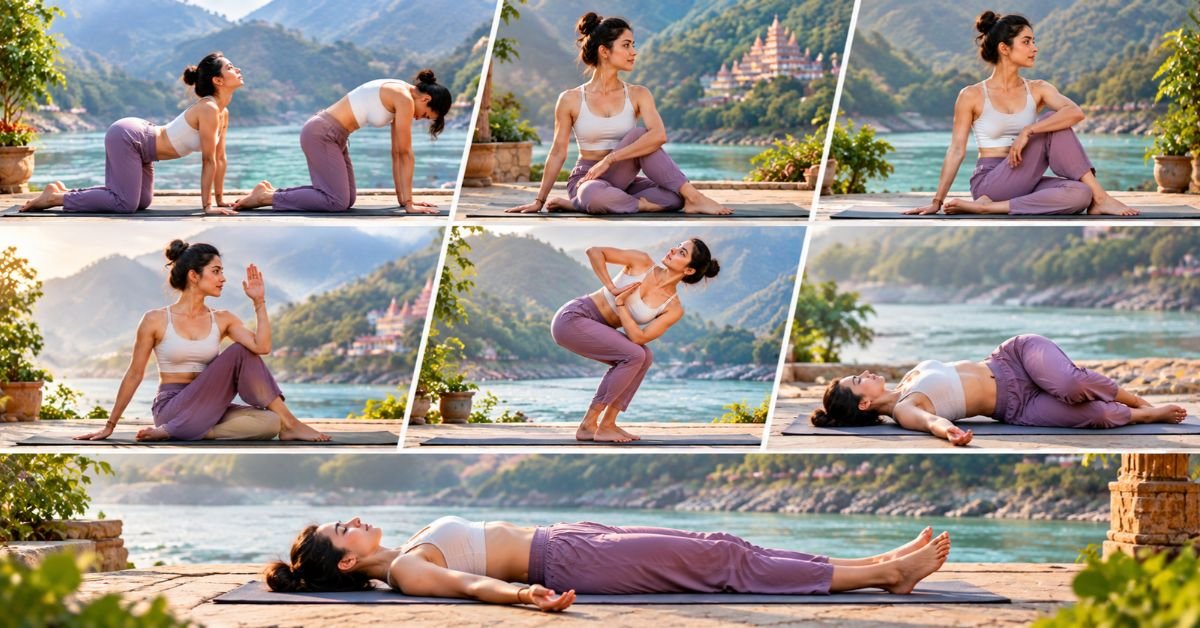
- Cat-cow: 1 minute
- Easy seated twist: 2 minutes (both sides)
- Bharadvaja’s twist: 2 minutes (both sides)
- Half Lord of the Fishes, easier version: 3 minutes (both sides)
- Revolved chair pose: 2 minutes (both sides)
- Supine spinal twist: 3 minutes (both sides)
- Final rest in Savasana: 2 minutes or longer
After the twists, a gentle forward fold such as Child’s Pose helps the spine neutralize. Once you feel warm and comfortable, you can explore a deeper fold such as Tortoise Yoga. For more seated shapes to try, see Pretzel Yoga.
Spinal Twist Yoga for Desk Workers and Students
Students spend hours in chairs, on buses, and on long flights. Short breaks fit easily between classes:
- Every hour, sit tall and take three slow chair twists on each side.
- After a flight or a long train ride, add a supine twist before bed.
- Keep your shoulders away from your ears, and let the ribs do the turning.
- Pair each twist with a slow breath: lengthen on the inhale, rotate on the exhale.
Short and frequent beats long and forced.
Common Mistakes in Twist Yoga
- Twisting from the lower back. Rotate from the middle back and ribs instead.
- Pulling with the arms. Use the hands for support, not leverage.
- Lifting one hip or shoulder. This breaks your base and reduces the twist.
- Holding the breath. If the breath stops, ease off.
- Cranking the neck. Let the head follow the spine.
- Going deeper for photos. Depth means little without control.
- Twisting right after a meal. Wait a couple of hours.
- Ignoring pain. Sharp or pinching sensations mean come out slowly.
Twist Yoga in Rishikesh: Practical Tips
Class in Rishikesh puts a teacher’s eyes on your alignment, which is the biggest help with twisting. Winter mornings can be cool and stiffen the back, so warm up longer. Monsoon humidity can make mats slippery, so choose a non-slip mat.
Tell the teacher about any injury before class. Ask Savasana Yoga School about class size, level groups, and how teachers modify twists for students with back concerns. A few more tips for international students:
- Arrive a day or two early to recover from travel before long holds.
- Drink water through the day.
- Move slowly through the first week while the body adjusts to daily practice.
Final Words
Good twists feel like wringing out a towel gently, not wrestling with it. Start with the chair twist and the supine twist, learn to lengthen before you turn, and add one new pose at a time. In a few weeks, you may find the spine rotates more easily and the breath comes with it.
Common Asked Questions
Q. Are twists good for digestion?
Q. How long should I hold a twist?
Q. Can twist yoga cause back pain?
Q. Is it better to practice twists before or after eating?
Q. What is the difference between open and closed twists?
Q. Does twist yoga detox the body?
Q. Which twist is best for a beginner?
Comments (0)
Share a respectful question or reflection. Every comment is reviewed before it appears.
Be the first to start a thoughtful conversation.